
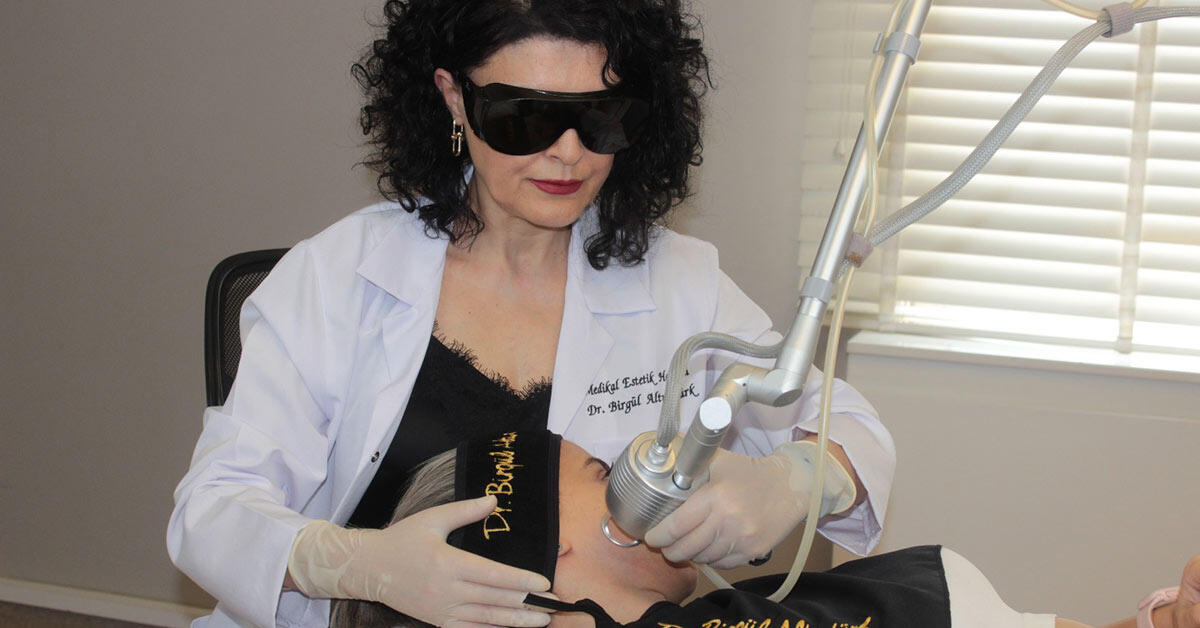
Carbon Dioxide Fractional Laser
During the normal aging process, harmful factors affecting the skin’s microcirculation, such as air pollution, sun damage, irregular diet, irregular sleep, dehydration, alcohol, and smoking, accelerate collagen breakdown. As the amount of collagen, the main protein of connective tissue, decreases in the skin, wrinkles begin to appear. Furthermore, we may face problems such as deep acne scars due to imbalances in the skin’s oil production or adolescent skin problems, scar tissue from trauma or previous surgeries, sunspots due to photodamage, and age spots.
Unlike conventional CO2 lasers that affect the entire skin surface, CO2 fractional lasers used in skin rejuvenation (anti-aging) create microscopic columns in the skin. The primary target in these areas is water. That is, water-containing structures such as collagen, blood vessels, and keratinocytes are selectively subjected to thermal damage. Living cells in the undamaged tissues immediately adjacent to the thermally damaged area migrate towards the damaged tissue, stimulating the repair mechanism there.
Thus, they initiate new collagen production under the skin. The most important feature of new generation CO2 fractional lasers is that they perform their function under the skin without damaging the skin’s surface, thus enabling faster healing and allowing individuals to return to their socio-cultural lives in a shorter time.
In which areas is the CARBON DIOXIDE FRACTIONAL LASER system used?
Anti-aging (skin wrinkles and skin tightening)
Acne scars
Burn and wound scars
Postpartum stretch marks (Striae)
Removal of age and sun spots
Pregnancy mask (melasma)
Peeling (Skin peeling)
Callus and wart treatments
Special adapter, accessory and ready-made protocol options for use in Plastic Surgery, Dermatology, Dentistry, ENT, Gynecology and other disciplines…
When can one return to normal life after CARBON DIOXIDE FRACTIONAL LASER treatment?
This depends on the extent of skin damage. Depending on whether the treatment is deep or superficial, it can last between 1 and 4 days. Redness and swelling may occur for up to 2 days.
What should the intervals between Carbon Dioxide Fractional Laser treatment sessions be? When does the effect of the treatment begin?
Session intervals should be between 3 and 4 weeks. The effect of the treatment begins to be seen after 3 months. This is because collagen production is completed within 3-6 months.
Who should not undergo Carbon Dioxide Fractional Laser treatment?
Pregnant women, those with active skin infections, acne, and herpes, and those with a history of using isotretinoin in the last 3 months should not undergo this treatment.
Can combination treatments be applied with Carbon Dioxide Fractional Laser treatment?
Combination treatments can be performed with all anti-aging applications recommended by your doctor. Clinically, it has been observed that good results are obtained, especially with treatments that support the wound healing process, such as CGF (Concentrated Growth Factor) and PRP.
Leave a Reply